
Jalandhar Police Recover 51 Illegal Pistols Since January 2026, Strengthen Intelligence-Led Action Against Organised Crime: DGP Gaurav Yadav
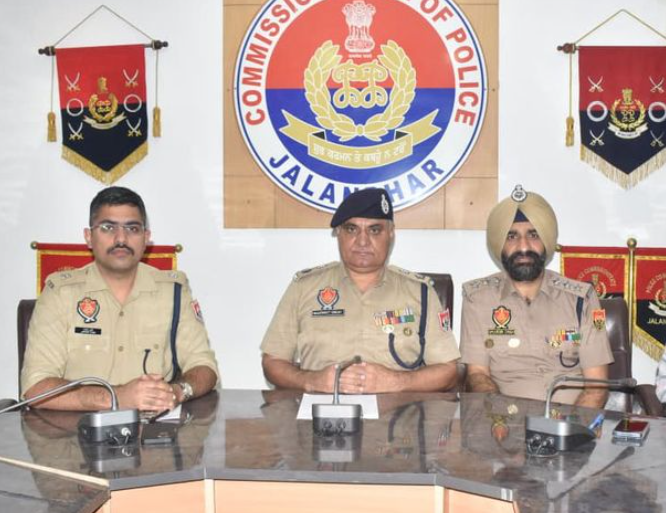
Organised Crime Networks Under Sustained Pressure as Jalandhar Police Intensify Crackdown: CP Satinder Singh
CHANDIGARH/JALANDHAR, August 7 ,2026 Fact Recorder
Punjab Desk: From cracking various crimes involving international gangsters to damaging the networks of drug traffickers, Commissionerate Police Jalandhar has ensured that the space in which organised crime can survive has narrowed.
This favourable outcome is the result of a modern policing strategy and better coordination, as the district police targeted illegal finances, weapons, mobility, anonymity and recruitment of various crime syndicates.
Ensuring the implementation of every project launched by Punjab Police, Commissionerate Police Jalandhar registered 1,201 cases under the NDPS (Narcotics Drugs and Psychotropic Substances) Act in the last seven months.
Under Punjab Police’s ‘Yudh Nashean Virudh’, Commissionerate Police has arrested 1,440 accused involved in drug trafficking. Police have seized 16.810 kg heroin, 119 grams methamphetamine (Ice), 9.274 kg opium, 24.624 kg ganja, 33.750 kg poppy husk, 20 grams cocaine, 15.200 kg charas and 3,130 intoxicating capsules/tablets, besides recovering Rs 11,17,900 believed to be proceeds of drug trafficking and vehicles used in narcotics offences. Every seizure not only removes drugs from the streets but also weakens the financial networks that sustain organised crime.
The crackdown does not stop there. It extends to the illegal weapons that fuel intimidation and violent crime. Parallel action under ‘Gangstran Te Vaar’ has focused on illegal arms suppliers, gang associates and facilitators. During the same period, Commissionerate Police recovered 51 illegal pistols and 133 live cartridges, while simultaneously identifying and maintaining surveillance over individuals supporting organised criminal groups. The objective is to weaken criminal networks by restricting their access to weapons and dismantling their support systems before violence occurs.
The net tightens further through sustained preventive policing. Commissionerate Police has deployed 45 Emergency Response Vehicles (ERVs) and 14 motorcycle patrol units manned by 209 police personnel, while permanent night nakas at key entry and exit points have strengthened surveillance across the city. Real-time verification through the VAHAN database has further reduced opportunities for criminals to move stolen or suspicious vehicles unnoticed.
Technology has further narrowed the room for criminals to operate. The Punjab Artificial Intelligence System (PAIS), the Integrated Command and Control Centre (ICCC), an expanding CCTV surveillance network and the Digital Forensic Laboratory have significantly strengthened scientific policing. Every investigation increasingly draws upon digital evidence, from CCTV footage and vehicle records to mobile phones and electronic devices, making it far more difficult for offenders to conceal their identities or erase their trail.
On this, Director General of Police (DGP) Gaurav Yadav said Punjab Police has fundamentally shifted its approach from responding to individual crimes to dismantling the criminal ecosystem that sustains organised crime. “Modern policing is no longer about isolated arrests or recoveries. It is about maintaining relentless pressure on organised criminal networks by simultaneously targeting their finances, weapons, logistics, technology and support systems. Intelligence-led operations, scientific investigation and community participation are helping us steadily reduce the operational space available to criminals across Punjab,” he said.
The strategy extends beyond enforcement to prevention. Recognising that addiction often fuels organised crime, Commissionerate Police Jalandhar has strengthened rehabilitation efforts to reduce the demand that sustains the illegal drug trade. Since January, as many as 1,300 individuals have been admitted to De-Addiction Centres, 1,509 referred to Outpatient Opioid Assisted Treatment (OOAT) Centres, and 504 eligible beneficiaries have received relief under Section 64-A of the NDPS Act.
Commissioner of Police Satinder Singh said the objective was to ensure that every operation weakens multiple links in the criminal chain rather than addressing offences in isolation. “Whether it is dismantling drug supply chains, recovering illegal weapons, identifying gang associates, leveraging technology or strengthening preventive policing, every intervention is designed to make organised crime increasingly difficult to operate and sustain. Our aim is not only to solve crimes but also to deny criminal networks the space, resources and confidence to function,” he said.
The approach has also delivered results in high-impact investigations. During the year, Commissionerate Police successfully cracked the BSF Chowk blast case, arresting key accused and uncovering links to Pakistan-based handlers. It also busted an anti-national module allegedly sharing sensitive information with Pakistan-based operatives, underscoring the growing role of intelligence-led policing and scientific investigation in tackling complex criminal conspiracies.
Beyond the statistics lies a larger transformation in policing. Commissionerate Police Jalandhar is no longer just solving crimes. It is systematically denying organised crime the space, resources and networks it needs to survive.